
Landing Page Optimization for Campaigns That Need More Useful Inquiries
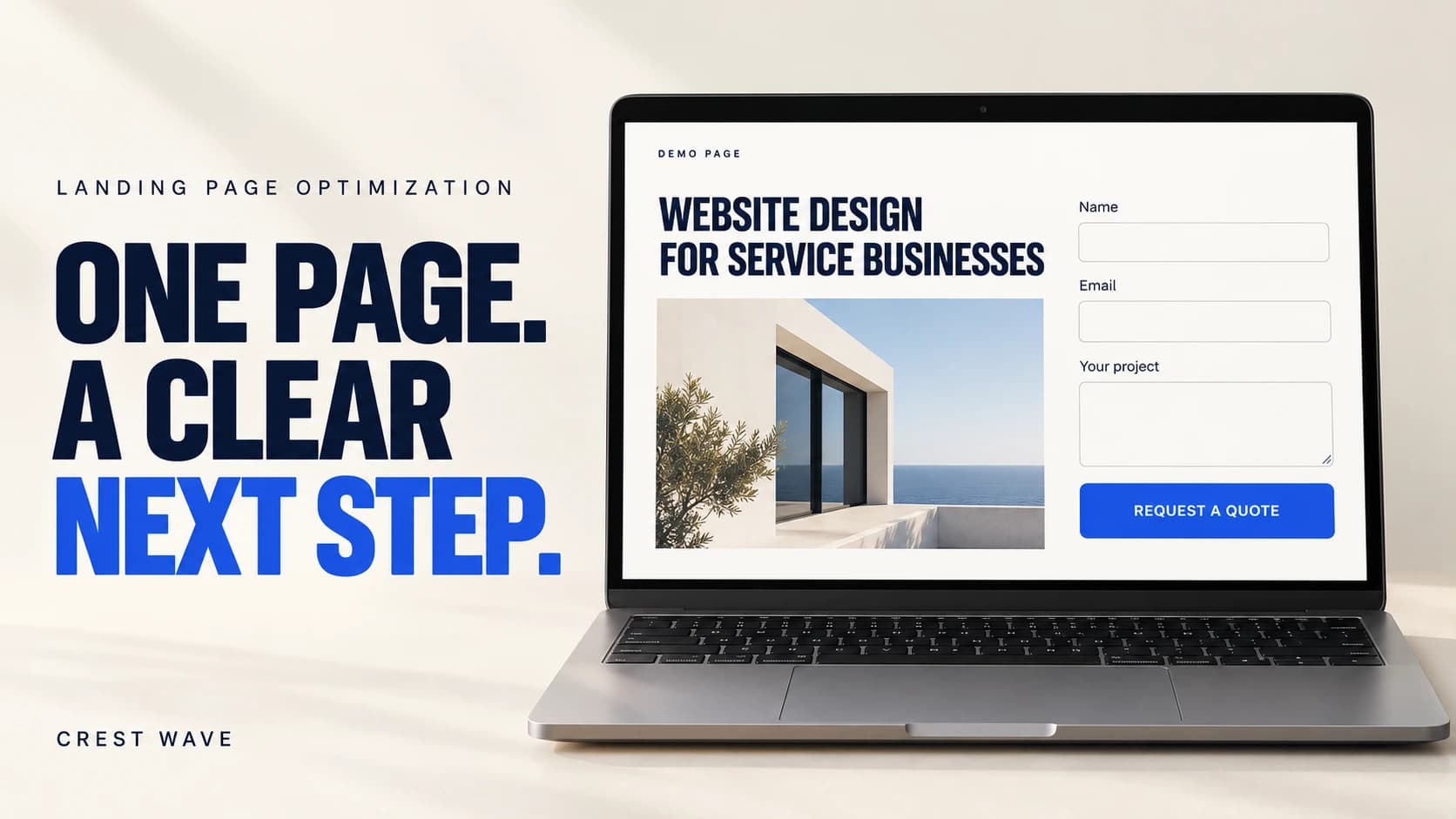
Article body starts below
Landing page optimization improves the page a customer reaches after clicking an advertisement or a relevant link. For a service business, the page should help a suitable visitor understand the offer, assess whether it fits and take a clear next step. Its performance depends on both the message and the working experience.
Begin with the visitor's expectation. Read the advertisement or search result that led to the page, then inspect the headline and opening content. If the promise changes between those points, the visitor must work harder to understand what is being offered.
Match the headline to the intended customer
State the service or offer in language the customer recognizes. Explain who it is for and what problem it addresses. Avoid filling the opening screen with broad claims that could describe any business.
A hypothetical campaign promoting a quote for a company website should lead to a page about that service. The page can explain the types of projects considered, what information is needed and how the inquiry proceeds. It should not require visitors to navigate through unrelated services to locate the advertised offer.
Answer the questions that affect a decision
Review recent sales conversations and list the uncertainties that prevent progress. Typical examples include scope, ownership, process, ongoing support and the information required for a quote. Use those questions to determine the content hierarchy.
Place the most relevant evidence beside the claim it supports. Show actual work where permission exists and explain your role accurately. A sample or demonstration must be labeled as such. Never use invented client logos, testimonials or performance numbers to fill empty space.
Give the next action a clear purpose
The button should tell visitors what happens next. A request for a project discussion needs different wording and fields from a purchase or booking. Explain whether the form begins a conversation or completes a transaction.
Ask only for information needed at that stage. A service inquiry might need contact details, the required service and a short description. Additional qualification can happen later where appropriate. Include a visible success message and a reliable internal handoff.
Inspect the page on a phone
Read the page at a normal mobile size. Check the order of information, text size, form controls and image behavior. Make sure sticky elements do not cover important content or the submit button. Try both successful and unsuccessful submissions.
Review loading and interaction problems with suitable technical tools. Do not describe the page as fast solely because it loaded quickly once on your own connection. Our guide to planning the visitor journey before website design can help connect these checks to the intended action.
Measure completed actions accurately
Define what counts as a conversion. A click on a contact button, a successfully submitted form and a qualified inquiry are separate events. Track the stages you can observe reliably, and avoid reporting them as interchangeable outcomes.
For example, if 200 campaign visits produce 10 valid inquiries, the inquiry rate for that group is 5%. This is a hypothetical calculation, not a benchmark or target. If only four of those inquiries fit the service, inspect both the page message and the audience that reached it.
Turn evidence into a focused improvement
If visitors repeatedly ask a question already answered far down the page, move or clarify the answer. If forms fail, fix the technical issue before changing the headline. If inquiries come from the wrong service area, make the coverage clear and review the campaign settings.
Keep a record of changes and their dates. When traffic is limited, qualitative evidence from real inquiries and usability checks may be more useful than declaring a statistical winner from a small test. Where controlled experiments are appropriate, choose a meaningful outcome and sufficient observation period.
Questions about landing pages
Does a landing page need to be short
Its length should match what the customer needs to decide. A simple offer may need little explanation. A complex service may need more detail, organized so readers can find the relevant answers.
Should every campaign use the homepage
Use the page that best matches the campaign's promise. A focused service or campaign page may provide a clearer route when the homepage covers several unrelated offers.
Can design alone solve low conversion
Design can improve clarity and usability, but pricing, service fit, campaign relevance and follow-up also affect outcomes. Landing page optimization should examine the complete path to a useful inquiry.
Crest Wave connects campaign messaging with website design and development. Send the page and the action you want visitors to complete.